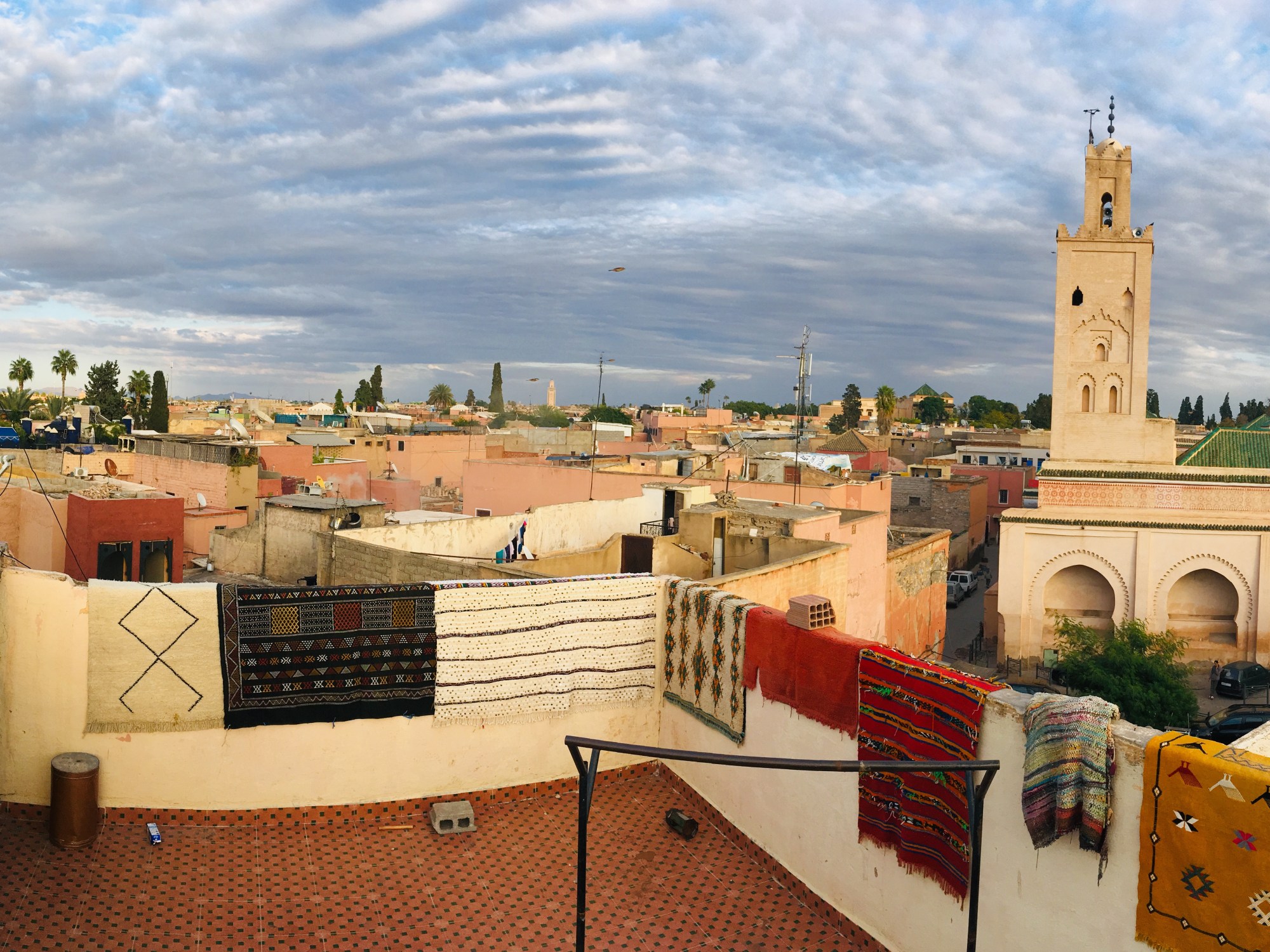
We did so much on the days we were away from Marrakech that there was no way that I could fit it all into one post. So, I loosely split it up into places and activities (my last post) and people (this post).
Khettara
Jamal took us to visit a man named Salam, who lives in the Tafilalt Oasis next to an ancient canal called a khettara. These khettara used to be filled with water and were built as an irrigation system for the oasis. According to Jamal and Salam, they are 3000 years old. I don’t know if that’s actually true; the only information I could find on them dates them to the 14th century, a date which is still very impressive. Salam said his family had lived there forever and that his ancestors had had a hand in making the canals.
When we went into his home, he offered us mint tea and we accepted–a ritual that has been followed in every place we’ve gone. By the by, the Moroccans have a really healthy diet–we have had fruit for dessert almost every time–but their mint tea is so sugary that it gives southern sweet tea a run for its money.


Salam proudly showed us the business cards of all the people who have come to visit him in Morocco–there were at least a hundred from all over the world. He was even given a smart phone from a man in Holland.
He lives alone and when I thoughtlessly asked about whether his family visited him in his home, he told me no. It was a unkind and inconsiderate thing for me to do. Everyone in Morocco lives with their family and it’s really important to take care of your parents. So when an older person doesn’t live with their family, it means that something bad has probably happened. Salam didn’t mind the question, but I felt terrible once I realized what I’d done.
Then Salam took us down to show us the canals. Surprisingly, I had a bout with claustrophobia; the stairs are very narrow, very dark, and very deep under the ground. I really didn’t want to go down, but Salam took my hand and down we went. He lit some candles and we followed the canal for a bit and took a few pictures with him. Back in the clear light of day, it seemed silly that I had been afraid.


Nomads
We also visited nomad camp. Contrary to my assumptions, nomads (in Morocco, at least) aren’t always wandering around; instead, they only move when they don’t have enough food for their sheep or camels. This is actually in the Greek root of the word–nomein means to wander in search of pasture, for those of you that love words like me. One of Jamal’s grandparents had been a nomad.
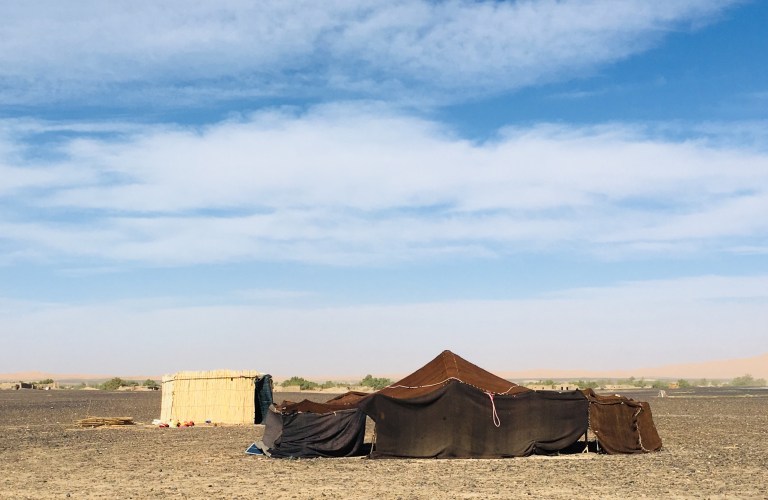
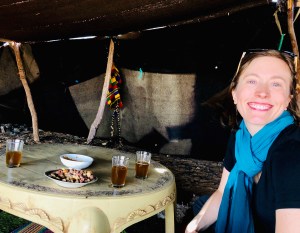
They of course offered us tea which we accepted. We met a few of them, but most of the men were with their animals, so they didn’t join us for the tea. They also brought us these nut-like snacks, bread, and a date and oil mix to dip the bread in. I realized about halfway through our visit that I had rudely forgotten to take my shoes off in the tent.
Gnoua Music
We also visited some Gnoua musicians. Gnoua is transliterated a few different ways–Gnawa, Gnaoua, etc. The music originates with the slaves of Sub-Saharan Africa; in the US, it morphed into blue music. I mentioned in an earlier post the krakebs which are used for some of the percussion; there is also a guitar/lute called a gimbri as well. Here is an older picture of me with a Gnoua musician in Marrakech so that you can see the instruments. The cowry shells on the hats are traditional as well.
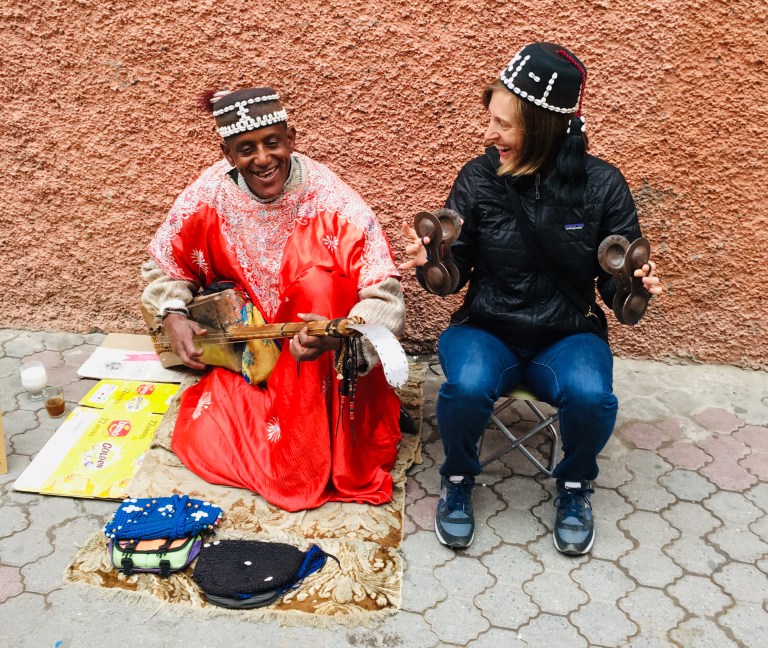
Because of my Always Volunteer rule, I ended up dancing. There was even a circle where we had to perform our own made-up dance to the music. People were very supportive.


This music is originally really sad music–it was sung by slaves or people being taken into slavery. Garett said the performers actually didn’t look very happy, even when people were dancing to their music. Maybe it’s because the subject of the music is somber.
A few last things
We have really enjoyed our time in Morocco–everyone has been so welcoming and kind to us. Even if at times we were uncomfortable, we have learned so much. Some random last things:
Jamal told us you can buy a donkey here for roughly $40. We have been measuring the cost of things in donkeys ever since.
This is our sweet neighborhood cat. We have named him Marshmallow.


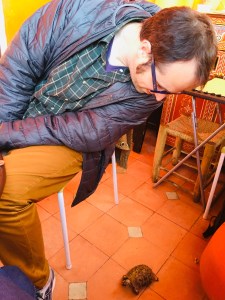
One of our favorite places to eat, Henna Cafe, has a “Find the Tortoise on our Terrace” challenge. We found him just the other day. His name is Terry, just like my dad. We fed him some of our salad.
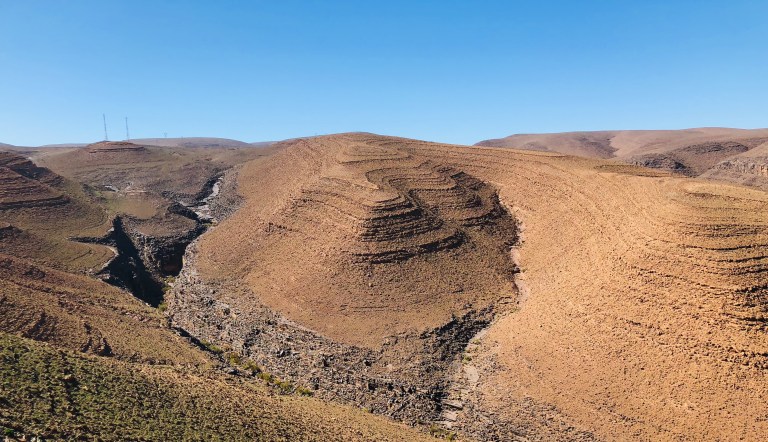
The Atlas Mountains have widely varying terrain. This part of the mountains looks like the whorls of fingerprints.
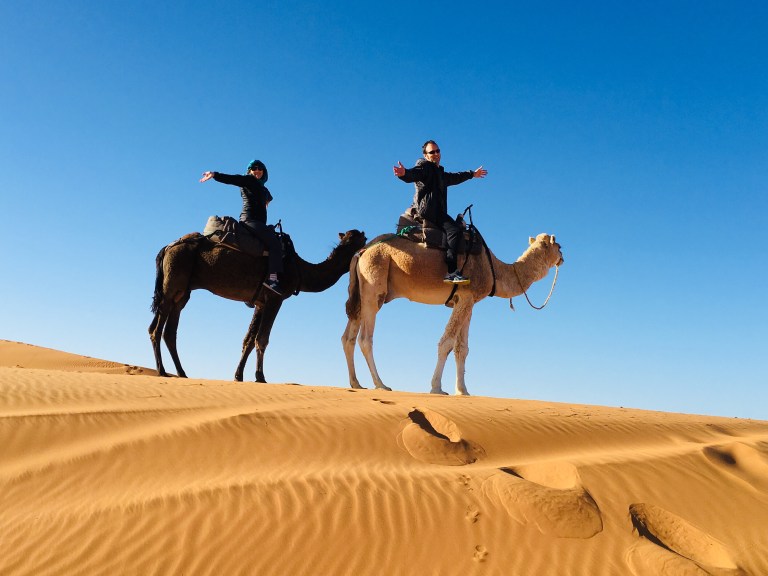
Here are our last pictures that didn’t make it into the blog thus far.
We were encouraged strongly to pose here.
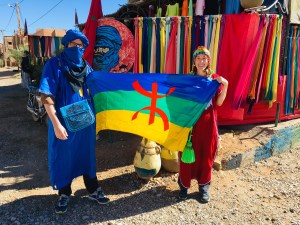
Jamal told us to say “yes” to everything at this shop, so we let them dress us up. Jamal often gave us advice about how to act because we really ain’t got no manners (see the stories above). This is the Berber flag and we are dressed up as Berbers. The symbol on the flag means “freedom.” Jamal told us that the proper name for the Berbers are the Amazigh or The Free People.
We are off to Madrid next. We get to see Marta and her family, our old neighbors from Atlanta! Plus, Garett’s mom and friend, Nancy, are coming to visit. It will be very eventful for us and we’re so excited about it.


Cannot wait to see you both. Love you, Mom from Wisconsin.
LikeLike